

RIRS Surgeon in Ahmedabad
If you are looking for a RIRS Surgeon in Ahmedabad for kidney stone treatment, choosing the right urologist is an important step in understanding your condition and selecting an appropriate treatment option. RIRS (Retrograde Intrarenal Surgery) is a minimally invasive procedure used to treat selected kidney stones with the help of a flexible scope and laser technology.
Dr. Ravi Jain provides evaluation and treatment for kidney stone conditions, with treatment planning based on factors such as the stone’s size, number, location, symptoms, medical history, and overall health.
If you are experiencing kidney stone pain, blood in the urine, difficulty passing a stone, or have been advised to undergo stone removal, a consultation can help determine whether RIRS or another kidney stone treatment may be appropriate for your condition.

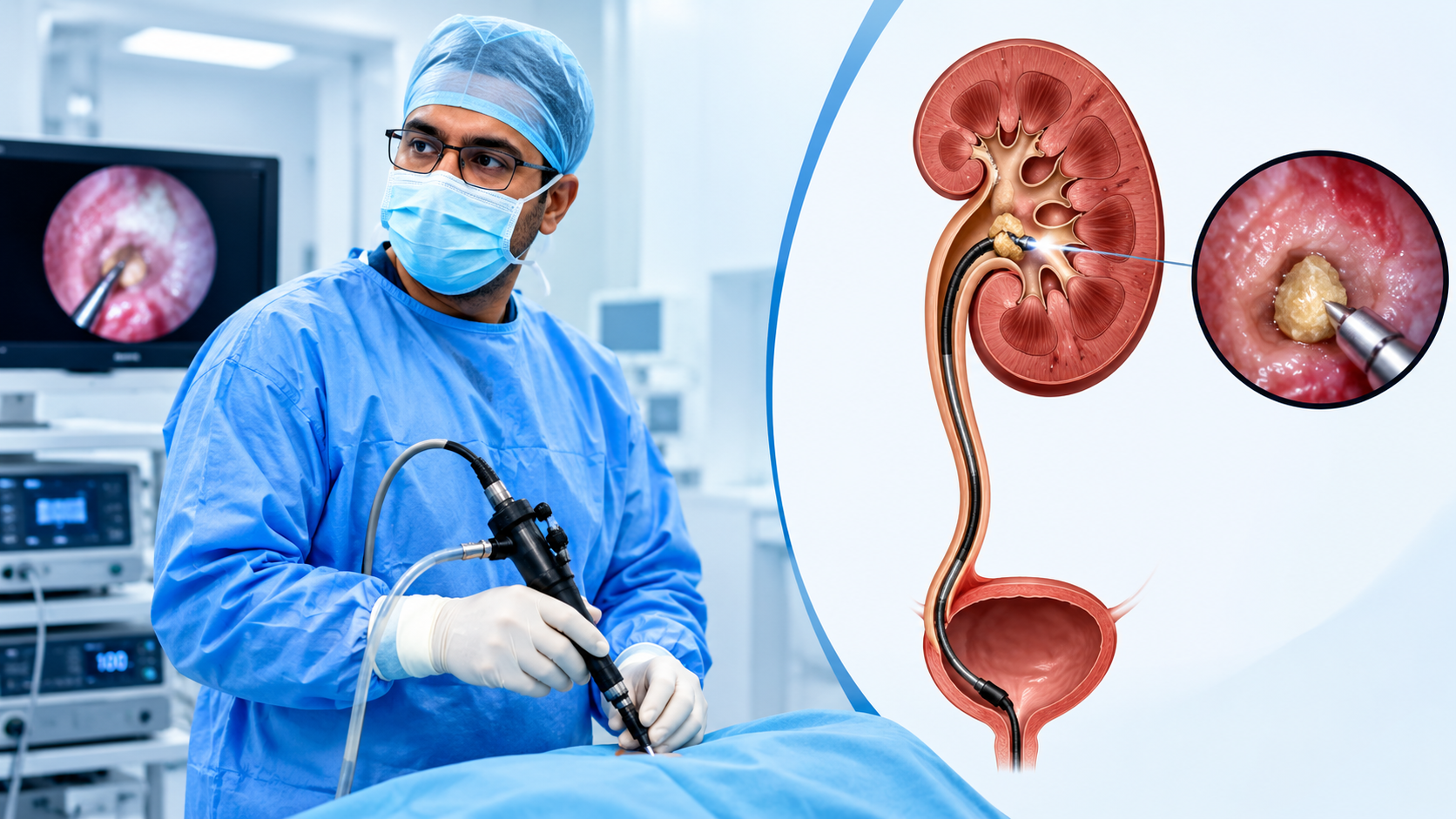
A Leading RIRS Surgeon in Ahmedabad
RIRS (Retrograde Intrarenal Surgery) is a minimally invasive procedure used to treat selected kidney stones. During the procedure, a flexible ureteroscope is passed through the urinary tract to reach the kidney and identify the stone. Laser energy may then be used to fragment the stone into smaller pieces for removal or natural passage.
Dr. Ravi Jain provides evaluation for patients with kidney stones and considers RIRS based on the individual clinical situation. The decision to recommend RIRS may depend on factors such as the size, number, location, and composition of the stone, along with the patient’s symptoms, medical history, kidney function, and previous treatment.
A detailed assessment helps determine whether RIRS is appropriate or whether another kidney stone treatment, such as ESWL, URS, PCNL, or Mini PCNL, may be more suitable.
If you have been diagnosed with a kidney stone or have been advised to undergo stone removal, consult a urologist to discuss the appropriate treatment option for your condition.
Complete RIRS Treatment in Ahmedabad
RIRS (Retrograde Intrarenal Surgery) is a minimally invasive procedure used to treat selected kidney stones. The procedure allows a urologist to reach the kidney through the natural urinary passage using a flexible ureteroscope. Depending on the size, number, location, and characteristics of the stone, laser energy may be used to fragment the stone into smaller pieces.
At Uro Health : Dr. Ravi Jain : Urologist In Ahmedabad, RIRS treatment begins with an assessment of the patient’s symptoms, medical history, previous stone treatments, and relevant imaging reports. The treatment approach is selected according to the individual stone characteristics and overall clinical condition.
RIRS may be considered when kidney stones are not suitable for observation or when a minimally invasive procedure is appropriate. Before recommending RIRS, the urologist evaluates factors such as stone size and location, urinary tract anatomy, infection status, and previous treatment history.
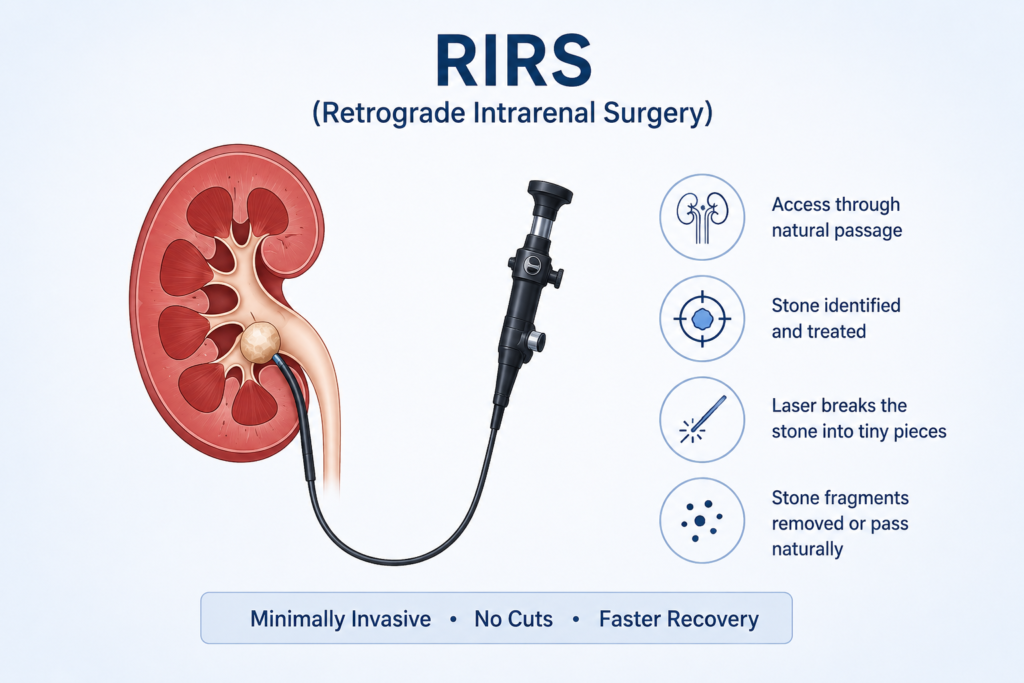
RIRS Treatment Process in Ahmedabad
RIRS treatment involves a planned sequence of evaluation, procedure, and follow-up. The exact approach may vary depending on the size, number, location, and characteristics of the kidney stone, as well as the patient’s overall health.
1. Initial Evaluation : The urologist reviews your symptoms, medical history, previous stone treatments, and available investigation reports. Imaging may be recommended to determine the location and size of the kidney stone.
2. Pre-Procedure Assessment: Before RIRS, the patient may undergo blood and urine tests or other investigations as considered appropriate. Any urinary infection needs to be assessed and managed before the procedure.
3. Flexible Ureteroscope: During RIRS, a thin flexible ureteroscope is passed through the urinary tract to reach the kidney. Because the procedure uses the natural urinary passage, it does not require an external incision to access the kidney.
4. Stone Fragmentation: When indicated, laser energy can be used through the ureteroscope to break the kidney stone into smaller fragments. The technique used depends on the stone’s characteristics and the treatment plan.
5. Stone Fragment Removal : Depending on the size and number of fragments, pieces may be removed with suitable instruments or allowed to pass naturally through the urinary tract.
6. Ureteric Stent: A temporary ureteric stent may be placed after RIRS when clinically required. The timing of stent removal depends on the individual case and the urologist’s recommendation.
7. Follow-Up : Follow-up after RIRS helps assess recovery and determine whether any residual stone fragments remain. Additional imaging or treatment may be recommended when appropriate.
The goal of RIRS treatment is to manage the kidney stone using an approach selected specifically for the patient’s stone characteristics and clinical needs.
Modern Facilities for RIRS Treatment
RIRS treatment requires appropriate diagnostic evaluation, endoscopic equipment, surgical facilities, and post-procedure monitoring. The treatment setup may vary according to the patient’s condition and the requirements of the procedure.
At Uro Health : Dr. Ravi Jain : Urologist In Ahmedabad, the evaluation and treatment plan for kidney stones is based on the patient’s symptoms, investigation reports, stone characteristics, and overall medical condition.
The RIRS treatment setup may involve:
- Pre-procedure evaluation: Review of medical history, symptoms, urine and blood investigations, and relevant imaging.
- Endoscopic equipment: A flexible ureteroscope is used to access the kidney through the urinary tract during RIRS.
- Laser equipment: When indicated, laser technology may be used to fragment kidney stones into smaller pieces.
- Anesthesia and monitoring: Appropriate anesthesia and monitoring are used according to the planned procedure and patient’s clinical requirements.
- Post-procedure care: Patients are monitored after the procedure and given appropriate instructions regarding medicines, hydration, activity, and follow-up.
- Follow-up assessment: Further evaluation may be advised to check recovery and assess for any remaining stone fragments.
The specific equipment and treatment approach used during RIRS depend on the individual procedure. A urologist can assess your kidney stone and explain whether RIRS is an appropriate treatment option for you.
Meet Dr. Ravi Jain – RIRS Surgeon in Ahmedabad
Dr. Ravi Jain is a urologist in Ahmedabad who provides evaluation and treatment for kidney stones and other urological conditions. His approach to kidney stone treatment begins with understanding the patient’s symptoms, medical history, investigation reports, and the characteristics of the stone.
For patients who may require RIRS, the treatment decision is based on factors such as the size, number, location, and nature of the kidney stone, along with the patient’s overall health and previous treatment history.
Dr. Ravi Jain provides consultation for kidney stone conditions and can assess whether RIRS is an appropriate treatment option or whether another stone treatment may be more suitable.
What Makes Dr. Ravi Jain a Trusted RIRS Surgeon in Ahmedabad?
Choosing a surgeon for kidney stone treatment involves understanding the diagnosis, available treatment options, and whether a particular procedure is appropriate for your condition. Dr. Ravi Jain focuses on evaluating each patient’s kidney stone before recommending a treatment approach.
For patients being considered for RIRS, the evaluation may take into account:
- Detailed Stone Assessment: The size, number, location, and characteristics of the kidney stone are considered before treatment planning.
- Individualized Treatment Planning: RIRS is recommended only when it is considered suitable for the patient’s particular condition.
- Clear Explanation of Treatment: Patients can discuss the procedure, expected recovery, possible stent placement, and follow-up requirements.
- Kidney Stone Treatment Options: Depending on the stone characteristics, different treatment approaches may be considered rather than using the same procedure for every patient.
- Pre- and Post-Procedure Guidance: Appropriate instructions and follow-up are provided as part of the treatment process.
- Focus on Appropriate Care: Treatment decisions are based on clinical evaluation, investigation findings, and the patient’s individual requirements.
If you have been diagnosed with a kidney stone or have been advised to consider RIRS, a consultation with Dr. Ravi Jain can help you understand your treatment options and whether RIRS is suitable for your condition.

Book Your Kidney Stone Treatment Visit
If you have been diagnosed with a kidney stone, are experiencing recurrent stone-related symptoms, or have been advised to undergo RIRS, a urological consultation can help determine the most appropriate next step.
During the consultation, Dr. Ravi Jain can review your symptoms, previous medical history, imaging reports, and other relevant investigations to understand the stone’s size, number, and location. Based on the evaluation, suitable treatment options can be discussed.
Before your appointment, you may bring:
- Previous ultrasound, CT scan, or X-ray reports
- Blood and urine investigation reports
- Previous treatment or surgery records
- Current medication details
- Any previous kidney stone-related prescriptions
The treatment approach is selected according to your individual clinical condition. If RIRS is appropriate, you can discuss the procedure, preparation, possible ureteric stent placement, recovery, and follow-up requirements with your urologist.
Schedule a consultation with Dr. Ravi Jain to discuss your kidney stone and understand whether RIRS is suitable for you.
Get Expert RIRS Surgery in Ahmedabad
RIRS may be recommended for selected kidney stones when endoscopic treatment is considered appropriate. The procedure uses a flexible ureteroscope to reach the kidney through the urinary tract, allowing the urologist to examine and treat the stone without making an external incision.
Dr. Ravi Jain evaluates the patient’s kidney stone before recommending RIRS. Factors such as stone size, number, location, urinary tract anatomy, previous treatment, and overall health may influence the treatment decision.
During a consultation, you can discuss:
- Whether RIRS is suitable for your kidney stone
- How the procedure is performed
- Whether laser stone fragmentation may be required
- Whether a ureteric stent may be placed
- Expected recovery and follow-up
- Other available kidney stone treatment options
Since kidney stones can differ considerably from one patient to another, the most appropriate procedure cannot be determined by the stone diagnosis alone. A proper urological assessment is important before choosing treatment.
Consult Dr. Ravi Jain for an evaluation of your kidney stone and discuss whether RIRS is an appropriate treatment option for your condition.
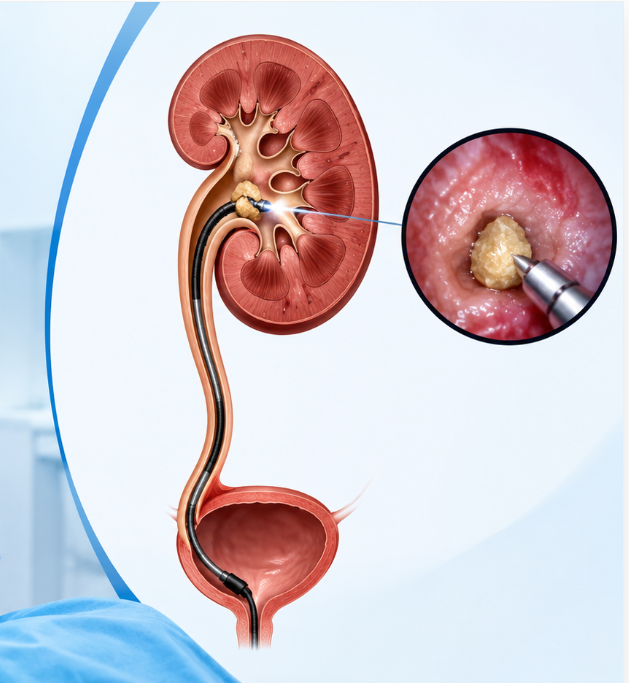
What Is RIRS Surgery?
RIRS stands for Retrograde Intrarenal Surgery. It is a minimally invasive endoscopic procedure used to treat selected kidney stones. During RIRS, a thin, flexible ureteroscope is passed through the natural urinary passage to reach the kidney and locate the stone.
If required, laser technology can be used to fragment the stone into smaller pieces. Depending on the stone and the treatment plan, the fragments may be removed using suitable instruments or may pass naturally through the urinary tract.
Unlike procedures that require an incision to access the kidney, RIRS is performed through the urinary tract. A temporary ureteric stent may be placed after the procedure when clinically indicated.
How Does RIRS Work?
During RIRS, a flexible ureteroscope is passed through the natural urinary passage to reach the kidney and locate the stone. When required, laser energy is used to break the stone into smaller fragments, which may be removed or passed naturally. A temporary ureteric stent may be placed when clinically necessary, followed by appropriate follow-up to assess recovery and any remaining stone fragments.
RIRS is not suitable for every kidney stone. The choice of treatment depends on factors such as stone size, number, location, anatomy, and the patient’s overall clinical condition.
When Is RIRS Surgery Recommended?
RIRS may be considered when a kidney stone requires active treatment and an endoscopic approach is appropriate. The decision is based on the patient’s symptoms, stone size, number, location, urinary tract anatomy, previous treatment, and overall health.
RIRS may be considered in situations such as:
- Kidney stones that are unlikely to pass naturally
- Stones located in parts of the kidney where endoscopic treatment may be suitable
- Stones causing recurrent pain or urinary symptoms
- Kidney stones that require active removal after medical evaluation
- Selected stones for which RIRS is considered more appropriate than other available procedures
- Residual or recurrent stones in selected patients after previous treatment
Not every kidney stone requires RIRS, and another treatment may be more suitable depending on the individual case. Dr. Ravi Jain can evaluate the stone and discuss the appropriate treatment option based on the patient’s clinical findings and investigation reports.
Symptoms of Kidney Stones
Kidney stones can cause different symptoms depending on their size and location. Common symptoms may include sharp pain in the side or back, pain that moves toward the lower abdomen or groin, blood in the urine, burning while urinating, frequent urination, nausea, or vomiting.
Some kidney stones may not cause noticeable symptoms and may be detected during imaging performed for another reason. Fever or chills along with suspected urinary infection and a blocked urinary tract requires prompt medical evaluation.
If you experience persistent or recurrent symptoms, a urological assessment can help determine whether a kidney stone is present and whether treatment is required.
Causes of Kidney Stones
Kidney stones develop when certain substances in the urine become concentrated and form crystals that gradually grow into stones. Several factors can contribute to stone formation.
These may include low fluid intake, dietary factors, increased levels of certain substances in the urine, family history, previous kidney stones, some medical conditions, and certain medications.
The exact cause can vary from one person to another. Understanding the possible contributing factors can help with treatment planning and future stone prevention.
Diagnosis Before RIRS Surgery
Before considering RIRS, the kidney stone needs to be evaluated carefully. The assessment may include a review of symptoms, medical history, previous stone treatments, physical examination, and relevant investigations.
Imaging such as ultrasound, X-ray, or CT scan may be used to assess the stone’s size, number, and location. Urine testing may also be recommended, particularly to check for infection. Blood tests and other investigations may be advised depending on the patient’s condition.
This evaluation helps the urologist determine whether RIRS is appropriate and plan the procedure according to the individual stone characteristics.
RIRS Surgery: Treatment, Recovery, Risks, and Cost
RIRS is a minimally invasive procedure used to treat selected kidney stones. The suitability of RIRS depends on factors such as the size, number, location, and characteristics of the stone, along with the patient’s urinary tract anatomy and overall health.
RIRS Surgery for Different Types of Kidney Stones
RIRS may be considered for different kidney stone situations when an endoscopic approach is appropriate. The treatment plan is determined after evaluating the individual stone.
RIRS for Small Kidney Stones: Some small stones may pass naturally and may not require surgery. When active treatment is required, RIRS can be considered in selected cases based on the stone’s location and the patient’s symptoms.
RIRS for Multiple Kidney Stones: When multiple stones are present, the number, size, and location of the stones are assessed to determine the most appropriate treatment approach. RIRS may be considered for selected patients.
RIRS for Lower Pole Kidney Stones: Lower pole stones can sometimes be more difficult to access because of kidney anatomy. RIRS may be considered depending on the stone characteristics and individual anatomy.
RIRS for Difficult-to-Reach Kidney Stones: A flexible ureteroscope can be used to access different areas of the kidney. Whether RIRS is appropriate depends on the stone’s position and the patient’s urinary tract anatomy.
RIRS with Laser Technology
During RIRS, laser energy may be used through the ureteroscope to fragment a kidney stone into smaller pieces. Depending on the size and characteristics of the fragments, they may be removed or allowed to pass naturally. The use of laser and the technique selected depend on the individual procedure.
Benefits of RIRS Surgery
For appropriately selected patients, RIRS offers a minimally invasive approach to kidney stone treatment. It is performed through the natural urinary passage rather than through an external incision to access the kidney.
Potential advantages may include:
No external incision to access the kidney
Ability to reach stones located within different parts of the kidney
Laser fragmentation when clinically required
Treatment of selected kidney stones through an endoscopic approach
Recovery that may be shorter than some more invasive procedures in appropriate cases
The expected outcome and recovery vary from patient to patient.
RIRS vs Other Kidney Stone Treatments
RIRS is one of several procedures available for kidney stone treatment. The choice depends on the stone and the patient’s clinical condition.
RIRS vs ESWL: ESWL uses shock waves from outside the body to break stones into smaller fragments, while RIRS uses a flexible ureteroscope to reach the stone from inside the urinary tract. The appropriate option depends on factors such as stone size, location, and other clinical considerations.
RIRS vs URS: Both procedures use an endoscope through the urinary tract. RIRS generally uses a flexible ureteroscope to access the kidney, while ureteroscopy may be used for stones in the ureter and selected areas of the urinary tract. The choice depends on where the stone is located and its characteristics.
RIRS vs PCNL: PCNL accesses the kidney through a small tract created through the skin. RIRS reaches the kidney through the natural urinary passage. PCNL may be considered for certain larger or complex kidney stones, while RIRS may be suitable for selected stones.
RIRS Surgery Preparation
Preparation for RIRS may include reviewing your medical history, medications, previous stone treatments, and investigation reports. Imaging may be reviewed to understand the stone’s size and location. Urine testing may be required to assess for infection, and blood tests or other investigations may be recommended according to the patient’s condition.
Your urologist will also provide instructions regarding medicines, food and fluid intake, and other preparation requirements before the procedure.
Recovery After RIRS Surgery
Recovery after RIRS varies depending on the procedure, stone characteristics, and the patient’s overall health. Some patients may experience temporary discomfort, urinary frequency, mild burning during urination, or blood in the urine after the procedure.
Follow your urologist’s instructions regarding medicines, activity, hydration, and follow-up. Contact your medical team if you experience significant pain, fever, difficulty passing urine, or other concerning symptoms.
Ureteric Stent After RIRS
A ureteric stent may be placed after RIRS when clinically required. The stent helps maintain urine flow through the ureter while the urinary tract recovers.
Some patients may notice urinary frequency, urgency, discomfort, or mild blood in the urine while the stent is in place. A stent is usually temporary, and its removal or replacement is planned according to the individual case.
Possible Risks and Complications of RIRS
Like any medical procedure, RIRS can have potential risks and complications. These may include discomfort, blood in the urine, urinary infection, ureteric injury, difficulty passing urine, residual stone fragments, or the need for additional treatment.
The likelihood of complications varies depending on the patient’s condition and the complexity of the stone. Your urologist can explain the potential risks and expected recovery before the procedure.
Can Kidney Stones Come Back After RIRS?
RIRS treats the existing kidney stone but does not necessarily prevent new stones from forming in the future. Kidney stones can recur because of factors such as inadequate fluid intake, dietary factors, family history, certain medical conditions, and previous stone formation.
Follow-up and appropriate preventive measures can help reduce the risk of future stones. Depending on your history, your urologist may recommend dietary changes, increased fluid intake, stone analysis, or additional evaluation.
Kidney Stone Prevention After RIRS
Preventing future kidney stones is an important part of long-term stone care. Drinking adequate fluids is generally important, while dietary recommendations may depend on the type of stone and individual risk factors.
Patients with recurrent stones may benefit from further evaluation to identify factors contributing to stone formation. Following your urologist’s recommendations can help develop an appropriate prevention plan.
RIRS Surgery Cost in Ahmedabad
The cost of RIRS surgery in Ahmedabad can vary from patient to patient. Factors that may influence the overall cost include the size and number of stones, complexity of the procedure, investigations, anesthesia, hospital stay, medicines, use of a ureteric stent, and any additional treatment that may be required.
Because the treatment plan is different for every patient, an exact cost can be discussed after Dr. Ravi Jain evaluates your kidney stone and recommends the appropriate treatment.
If you have been advised to undergo RIRS or are looking for a RIRS surgeon in Ahmedabad, bring your previous scans and medical reports for a proper evaluation and discussion of suitable treatment options.
When Should You Consult a RIRS Surgeon?
You may consider consulting a RIRS surgeon when you have been diagnosed with a kidney stone that requires active treatment or when your urologist has advised an endoscopic procedure. A consultation can help determine whether RIRS is suitable based on the stone’s size, number, location, and characteristics.
You should consider a urological evaluation if you experience:
- Recurrent or severe pain related to kidney stones
- Blood in the urine
- Repeated kidney stone formation
- A kidney stone that is not passing naturally
- A stone that requires active removal
- Multiple kidney stones
- A kidney stone located in a difficult-to-treat area
- Previous kidney stone treatment with remaining or recurrent stones
- A recommendation for RIRS or another stone removal procedure
RIRS is not required for every kidney stone. Some stones can be managed with observation or other treatment options. Dr. Ravi Jain can review your symptoms, imaging reports, medical history, and stone characteristics to determine whether RIRS or another treatment approach is appropriate for you.
Frequently Asked Questions About RIRS Surgery
RIRS (Retrograde Intrarenal Surgery) is a minimally invasive procedure used to treat selected kidney stones. A flexible ureteroscope is passed through the urinary tract to reach the kidney. When required, laser energy can be used to fragment the stone, and the fragments may be removed or allowed to pass naturally.
RIRS is generally considered a minimally invasive procedure when performed in appropriately selected patients. However, like any surgical procedure, it can have potential risks such as bleeding, infection, discomfort, ureteric injury, or residual stone fragments. Your urologist can explain the potential risks based on your individual condition.
The duration of RIRS can vary depending on the size, number, location, and complexity of the kidney stones. The time required can also differ according to the individual patient’s anatomy and the treatment approach.
A ureteric stent may be placed after RIRS when clinically required. The stent is usually temporary and helps maintain urine flow while the urinary tract recovers. The duration of stent placement depends on the individual case.
Recovery varies between patients depending on the procedure, stone characteristics, and overall health. Some patients may experience temporary urinary discomfort, frequency, or blood in the urine after RIRS. Your urologist will provide specific instructions regarding activity, medicines, hydration, and follow-up.
RIRS can be considered for selected patients with multiple kidney stones. The treatment plan depends on the number, size, and location of the stones, as well as the patient’s anatomy and overall clinical condition. In some cases, more than one treatment session may be considered.
Neither procedure is universally better. RIRS and PCNL are different kidney stone treatment approaches, and the choice depends on factors such as stone size, location, number, anatomy, and patient-specific considerations. PCNL may be considered for certain larger or complex stones, while RIRS may be appropriate for selected stones.
The cost of RIRS surgery can vary depending on the stone characteristics, investigations, procedure complexity, anesthesia, hospital stay, stent requirements, and other treatment-related factors. An exact cost can be discussed after evaluating the patient’s condition and determining the appropriate treatment plan.
Book an Appointment with Dr. Ravi Jain
If you have been diagnosed with a kidney stone or have been advised to consider RIRS, a consultation can help you understand your treatment options. Dr. Ravi Jain can review your symptoms, medical history, imaging reports, and stone characteristics to determine whether RIRS is appropriate for your condition.
Bring your previous ultrasound, CT scan, X-ray, blood or urine reports, and previous treatment records when available.