

Kidney Stone Treatment in Ahmedabad
Kidney stones can cause sudden and severe pain, urinary discomfort, blood in the urine, nausea, and other symptoms that can interfere with daily life. While some smaller stones may pass naturally, others may require specialist evaluation and a procedure to remove them.
If you are looking for Kidney Stone Treatment in Ahmedabad, Dr. Ravi Jain provides specialist urological evaluation and treatment for kidney stones, including RIRS (Retrograde Intrarenal Surgery) for appropriate cases. The recommended treatment depends on factors such as the stone’s size, location, number, symptoms, and your overall condition.
The goal is to identify the stone accurately and choose an appropriate treatment approach rather than using the same treatment for every patient.
What Are Kidney Stones?
Kidney stones are hard, crystal-like deposits that develop when certain substances in urine become concentrated and form crystals. These crystals can gradually grow into stones inside the kidney. A kidney stone may remain in the kidney without causing noticeable symptoms. When it moves into the ureter, it can interfere with urine flow and cause significant pain. Kidney stones can vary in size, composition, number, and location. These factors are important when deciding whether a stone can be observed or whether treatment may be required.
How Do Kidney Stones Form?
Kidney stones can develop when there is an imbalance between substances that promote crystal formation and substances that normally help prevent it.
Factors that may contribute to stone formation include:
- Inadequate fluid intake
- Concentrated urine
- Certain dietary patterns
- Previous history of kidney stones
- Family history of stone formation
- Certain medical conditions
- Some medications
- Individual metabolic factors
The reason someone develops kidney stones can vary from person to person. For patients with recurrent stones, medical evaluation may help identify factors that could contribute to future stone formation.
Types of Kidney Stones
Kidney stones are not all made of the same material. Common types include:
Calcium Stones
Calcium-containing stones are among the most common types of kidney stones.
Uric Acid Stones
These can develop when urine contains high levels of uric acid and is more acidic.
Struvite Stones
These may develop in association with certain urinary tract infections.
Cystine Stones
These are less common and are associated with an inherited condition that causes cystine to accumulate in urine.
Knowing the stone type can sometimes help guide prevention strategies, particularly when stones recur.
Symptoms of Kidney Stones
Symptoms can vary depending on the stone’s size and location.
Common kidney stone symptoms include:
- Sharp pain in the side or back
- Pain that may move toward the lower abdomen or groin
- Pain that comes and goes in waves
- Blood in the urine
- Burning or discomfort while urinating
- Frequent or urgent urination
- Nausea or vomiting
- Difficulty passing urine
Some kidney stones may cause no symptoms at all and may be discovered during an imaging test performed for another reason.
When Kidney Stone Symptoms Need Prompt Medical Attention
Severe pain accompanied by fever, chills, persistent vomiting, difficulty passing urine, or significant urinary symptoms requires prompt medical assessment. A urinary obstruction associated with infection can become a serious medical problem and should not be ignored.
When Should You See a Urologist for Kidney Stones?
A urologist can evaluate kidney stones and determine whether observation, medical management, or a procedure may be appropriate.
Consider consulting a urologist if:
- You have persistent or severe stone-related pain
- A kidney stone has been identified on imaging
- You have recurrent kidney stones
- You notice blood in your urine
- A stone is not passing as expected
- You have repeated urinary symptoms associated with stones
- You have been advised that your stone may require a procedure
The treatment decision should be based on your individual diagnosis rather than the stone size alone.
How Are Kidney Stones Diagnosed?
Accurate diagnosis helps determine the most appropriate treatment.
Medical History and Examination
Your doctor may ask about your pain, urinary symptoms, previous kidney stones, medical history, medications, and family history.
Urine Tests
Urine testing may help identify blood, infection, or other findings relevant to the evaluation of kidney stones.
Blood Tests
Blood investigations may be recommended depending on your symptoms and clinical situation.
Ultrasound
Ultrasound can help identify certain kidney and urinary tract stones and assess the urinary system.
CT Scan
When clinically indicated, CT imaging can provide detailed information about the size, location, and number of stones and can help with treatment planning.
Kidney Stone Treatment Options
There is no single treatment that is suitable for every kidney stone.
The treatment approach can depend on:
- Stone size
- Stone location
- Number of stones
- Symptoms
- Urinary obstruction
- Clinical findings
- Previous stone history
- Overall health
Observation
Some smaller stones may be monitored when they are likely to pass naturally and there are no concerning complications.
Medical Management
Depending on the individual case, a doctor may recommend appropriate medical management and follow-up.
Procedural Treatment
Some stones may require a procedure when they are causing significant symptoms, obstruction, are unlikely to pass naturally, or require active removal.
The appropriate procedure is selected after evaluating the individual stone and patient.
RIRS for Kidney Stone Treatment
What Is RIRS?
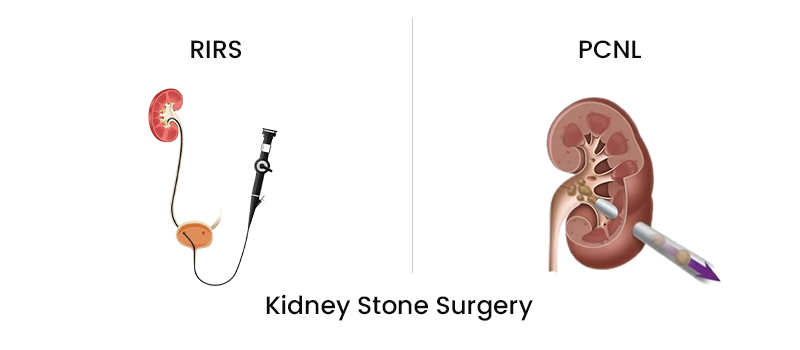
RIRS (Retrograde Intrarenal Surgery) is a minimally invasive procedure used for the treatment of selected kidney stones.
During RIRS, a flexible instrument called a ureteroscope is passed through the natural urinary pathway to reach the kidney. Once the stone is located, laser energy can be used to break it into smaller fragments. Because the procedure uses the natural urinary passage, it does not require an external surgical incision.
How Does RIRS Work?
The procedure generally involves:
- Accessing the urinary tract through the natural passage
- Guiding a flexible ureteroscope toward the kidney
- Identifying the stone
- Using laser energy to fragment the stone when appropriate
- Removing or allowing the resulting fragments to pass, depending on the clinical situation
- Providing appropriate follow-up after the procedure
The exact approach can vary depending on the stone and the patient’s anatomy.
Who May Be Considered for RIRS?
RIRS may be considered for selected patients based on factors such as:
- Stone location
- Stone size
- Number of stones
- Urinary anatomy
- Previous treatment
- Symptoms and clinical findings
RIRS is not automatically the best option for every kidney stone. A urologist should assess the individual case before recommending the procedure.
Benefits of RIRS for Suitable Kidney Stones
For appropriately selected patients, RIRS offers a minimally invasive approach to treating kidney stones.
Potential advantages include:
- Access through the natural urinary pathway
- No external surgical incision
- Laser fragmentation of the stone
- Minimally invasive treatment
- Treatment of selected stones located within the kidney
The expected outcome and recovery can vary depending on the stone and individual patient factors.
Kidney Stone Treatment Based on Stone Size and Location
One of the most important aspects of stone treatment is understanding that size alone does not determine treatment.
A urologist may consider the following:
Stone Size
Larger stones may be less likely to pass naturally and may require active treatment.
Stone Location
A stone’s position within the kidney or urinary tract can influence which treatment approach is appropriate.
Number of Stones
Multiple stones may require a different treatment plan from a single stone.
Symptoms
Severe or recurrent pain may influence the decision to actively treat a stone.
Urinary Obstruction
A stone that interferes with urine flow may require more urgent evaluation.
Patient Factors
Overall health, previous procedures, anatomy, and other clinical factors may also influence treatment planning.
This is why a personalized urological evaluation is important before deciding on treatment.
Recovery After Kidney Stone Treatment
Recovery depends on the treatment performed and the individual patient’s condition.
After a minimally invasive procedure such as RIRS, some patients may experience temporary:
- Mild urinary discomfort
- Burning while urinating
- Small amounts of blood in the urine
- Urinary frequency
- Discomfort associated with a temporary ureteric stent, when one is used
Your doctor will provide specific instructions regarding medication, activity, hydration, follow-up, and stent management where applicable.
If you experience severe pain, fever, difficulty passing urine, or other concerning symptoms after treatment, contact your treating medical team promptly.
Can Kidney Stones Come Back?
Yes. Successfully treating a kidney stone does not necessarily prevent another stone from developing.
Some people are more prone to recurrent stone formation because of dietary, metabolic, genetic, medical, or lifestyle factors.
If you have had kidney stones more than once, discussing prevention and appropriate follow-up with your doctor may help identify factors that can be addressed.
How Can You Reduce the Risk of Kidney Stones?
Prevention depends on the individual’s stone type and risk factors.
General measures may include:
Maintain Adequate Hydration
Drinking an appropriate amount of fluid can help dilute substances in the urine that contribute to stone formation.
Follow Individualized Dietary Advice
Dietary recommendations may vary depending on the type of stone and individual risk factors.
Understand Your Stone Type
If a stone has been analyzed, its composition can provide useful information for prevention planning.
Follow Your Doctor’s Recommendations
Patients with recurrent stones may require specific evaluation or follow-up depending on their history.
There is no single diet or prevention plan that works for everyone.
Why Choose Dr. Ravi Jain for Kidney Stone Treatment in Ahmedabad?
Dr. Ravi Jain is a Consultant Urologist and Robotic & Renal Transplant Surgeon with expertise in urological care. His clinical focus includes kidney stone treatment, and his expertise includes RIRS, a minimally invasive approach used for selected kidney stones.
Specialist Urological Expertise
Kidney stones are part of the urinary system and may require specialist urological assessment when active treatment is needed.
RIRS Expertise
RIRS provides a minimally invasive approach for appropriate kidney stone cases, and Dr. Ravi Jain’s practice includes expertise in this procedure.
Individualized Treatment Planning
Every stone is different. Treatment is selected after considering the stone’s characteristics, symptoms, investigations, and individual clinical factors.
Focus on Minimally Invasive Treatment
Where clinically appropriate, minimally invasive techniques can provide an alternative to more invasive surgical approaches.
Kidney Stone Treatment in Ahmedabad: What Should You Expect?
When you consult a urologist for a kidney stone, the treatment journey may involve:
Step 1: Consultation
Your symptoms and medical history are reviewed.
Step 2: Diagnosis
Appropriate investigations are used to understand the stone’s size, location, and other characteristics.
Step 3: Treatment Planning
The urologist determines whether observation, medical management, or active stone removal is appropriate.
Step 4: Procedure When Required
For suitable cases, an appropriate minimally invasive procedure such as RIRS may be considered.
Step 5: Follow-Up
Follow-up helps assess recovery and address any remaining stone fragments or recurrent symptoms where applicable.
Step 6: Prevention
For patients at risk of recurrent stones, appropriate preventive advice can be discussed.
Frequently Asked Questions About RIRS Surgery
There is no single best treatment for every kidney stone. Treatment depends on factors including stone size, location, symptoms, obstruction, and the patient’s overall condition.
Some smaller stones can pass naturally, but whether observation is appropriate depends on the stone and the patient’s clinical condition.
No. Some stones can be monitored or managed conservatively. Active treatment may be recommended when a stone is unlikely to pass, causes significant symptoms, creates obstruction, or presents another clinical concern.
RIRS stands for Retrograde Intrarenal Surgery. It is a minimally invasive procedure in which a flexible scope is passed through the urinary tract to reach the kidney. Laser energy may be used to fragment selected kidney stones.
No. The suitability of RIRS depends on factors such as stone size, location, number, anatomy, and the patient’s individual condition.
RIRS is performed through the natural urinary pathway and does not require an external surgical incision.
Recovery varies from patient to patient and depends on the procedure, stone characteristics, and individual health. Your urologist will provide specific recovery instructions after treatment.
Yes. Kidney stones can recur. Identifying possible risk factors and following appropriate preventive recommendations may help reduce the likelihood of recurrence.
A urologist is the specialist who evaluates and treats many kidney-stone conditions, particularly when a procedure or surgical treatment may be required.
You should consider urological evaluation if you have persistent or severe pain, recurrent stones, blood in the urine, urinary symptoms, or a known stone that may require active treatment.
Get Kidney Stone Treatment in Ahmedabad
Don’t ignore persistent kidney-stone symptoms or recurring stone problems. A specialist evaluation can help determine the stone’s characteristics and whether monitoring, medical management, or active treatment is appropriate.
Dr. Ravi Jain provides specialist urological care for kidney stones, including RIRS for suitable cases. Book Your Consultation Today